

I spent some time digging into paid attribution in the beauty and cosmetics space. We all see what’s coming with social commerce and agentic commerce, and I wanted to understand more aspects of getting ready for it.
I chose to focus on beauty brands for this research because I needed a specific lens to examine attribution challenges, and this industry offers unique insights. Beauty products are inherently visual, deeply personal, and thrive on discovery, making them perfect for social commerce platforms where customers scroll, discover, and buy in one seamless experience. They’re also ideal for AI-driven recommendations because purchase decisions involve matching specific skin types, tones, and preferences that algorithms can learn and predict.
We’re moving into a world where customers will buy through TikTok Shops, AI assistants, voice commerce, and channels we haven’t even imagined yet. If you can’t properly track where your revenue comes from today with selling via conventional channels, how do you want to understand what’s going on when you add modern channels that don’t fit into typical tracking systems?
My research focused on one question: How well does attribution work right now, and what happens to companies that get it wrong?
What I found was both encouraging and alarming. The beauty brands that get attribution right are seeing predictably positive results. But many e-commerce businesses are flying blind, and that’s about to become a massive strategic risk.

Here are the 10 most compelling statistics I found:
1. Sephora measured 3.9X higher ROAS with omnichannel attribution
The Case: Sephora discovered that customers often research products online before purchasing in-store. By connecting their digital advertising data with in-store sales, they uncovered the true impact of their online campaigns.
The Result: When in-store sales were included in the path to purchase, Sephora saw a 3.9X higher return on ad spend (ROAS), and a 3X increase in conversion rates from its digital ads.
Why This Matters for Future Commerce: As AI shopping assistants recommend products across multiple touchpoints, tracking the complete journey becomes even more critical. If Sephora misattributed 75% of their true digital campaign impact, imagine the attribution gaps when customers interact through next-gen channels such as social shops, AI agents, and voice commerce.
Source: How Sephora Measured Offline Impact of Its Online Ads in Singapore
2. The mysterious 30% revenue drop when cutting “inefficient” campaigns
The Case: Beauty brands using basic attribution often see certain campaigns showing no direct conversions. When they cut these “inefficient” campaigns, they experience massive revenue drops because these channels were actually driving awareness and consideration.
The Result: SegmentStream shared a success story with one of their customers, L’Oréal. With brands such as Lancôme Mexico, they implemented fully automated cross-channel marketing reporting that resulted in a 57% increase in sales. Implementing such a cohesive tracking and attribution strategy helped to avoid misattributing sales performance. For some other brands, SegmentStream observed up to a 30% decline in total sales when they removed budget from what appeared to be “inefficient traffic sources.”
Why This Matters for Future Commerce: Social commerce thrives on discovery. Users aren’t always ready to buy immediately. They might see a product on TikTok, research it through an AI assistant, and then purchase it weeks later. Without an effective concept for multi-touch attribution, you’ll cut the very channels that introduce customers to your brand.
Source: Marketing Attribution for Beauty Brands – SegmentStream
3. MAC Cosmetics discovered 18% of ad spend was going to the wrong audience
The Case: MAC Cosmetics used people-based marketing to analyze who was actually seeing their ads, moving beyond cookie-based tracking to understand their real audience.
The Result: MAC found that 1/3 of media impressions (18% of spend) was going to men rather than women, their target audience. After fixing this, they achieved a 16% increase in conversions.
Why This Matters for Future Commerce: AI commerce will require even more precise audience understanding. If you’re wasting 18% of your budget on wrong audiences, defined by factors such as gender, with current tools, how much will you waste when AI agents are making purchasing decisions based on user preferences you can’t track?
Source: Digital Marketing Case Study – MAC Cosmetics
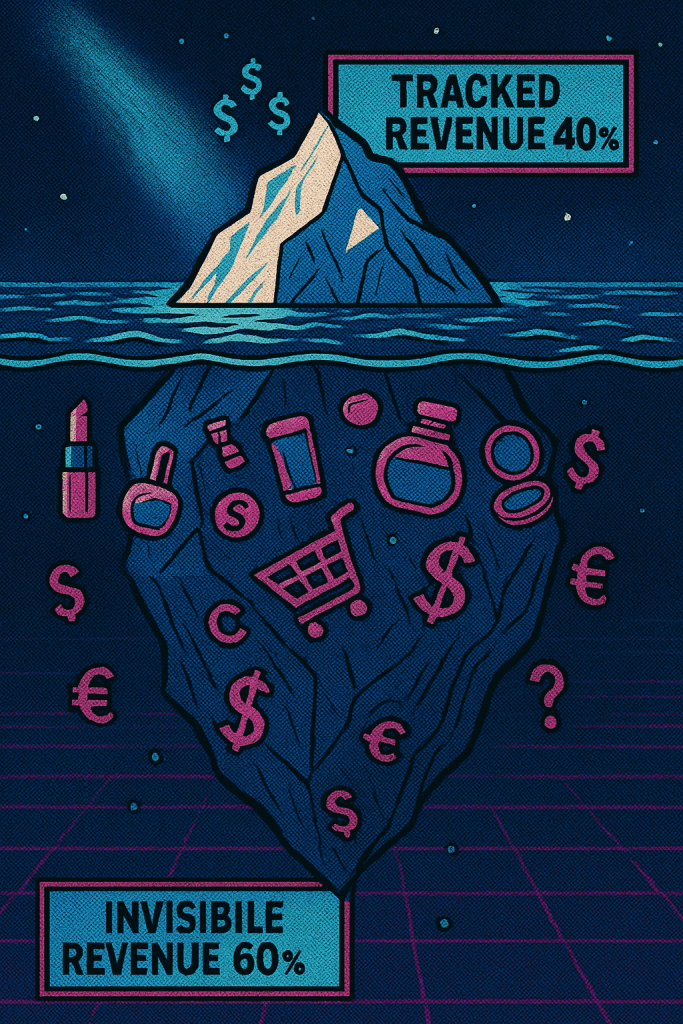
4. 60% of revenue is misattributed with current measurement methods
The Case: Fospha analyzed how much revenue businesses can actually track accurately using standard pixel-based measurement across their client base.
The Result: According to Fospha, 60% of revenue is misattributed when using pixel-based measurement, meaning businesses only have visibility into 40% of their true revenue sources.
Why This Matters for Future Commerce: If we’re already missing 60% of revenue attribution with cookies and pixels, the problem explodes with more complex traffic flows in social commerce and agentic commerce. You’ll be making huge marketing budget decisions based on a fraction of actual data.
Source: The New Era of Measurement: Unlock TikTok’s Impact on ROI
5. 79% of conversions are missed by last-click attribution
The Case: TikTok studied how many conversions they could verify came from their platform (through user surveys and advanced tracking) versus what traditional last-click attribution showed.
The Result: 79% of all conversions attributed to TikTok by users themselves were missed by last-click attribution models. Nearly 8 out of 10 sales were invisible.
Why This Matters for Future Commerce: TikTok is just the beginning. As commerce moves to Instagram shops, YouTube Shopping, and AI-powered discovery, last-click attribution becomes less useful to understand the impact of your entire marketing campaign system. Last-click attribution will mostly identify the channel or platform that led to the actual purchase. You will see AI agents over-attributed. That’s a phenomenon we already know from today’s data: Search engines see much higher numbers of attributed sales than other channels because of their relevance in the last step of the purchase funnel. You need attribution that captures the full journey, not just the final step.
Source: The New Era of Measurement: Unlock TikTok’s Impact on ROI
6. L’Oréal Nordics: 30% higher attributed ROAS through enhanced channel recognition
The Case: L’Oréal Nordics implemented Marketing Mix Modeling to understand the true performance of each marketing channel, particularly newer platforms like TikTok.
The Result: They discovered TikTok ROAS was on average 30% higher than other media channels. Performance that was completely hidden by their previous attribution model.
Why This Matters for Future Commerce: Each new commerce channel will have unique attribution challenges. If major brands like L’Oréal are undervaluing channels by 30%, imagine the missed opportunities as AI agents start recommending products through entirely new interfaces.
Source: The New Era of Measurement: Unlock TikTok’s Impact on ROI
7. Kitsch achieved 6X ROAS on Snapchat with proper attribution
The Case: Beauty accessories brand Kitsch achieved remarkable success on Snapchat by leveraging proper attribution tools to measure campaign effectiveness. They saw over a 6x ROAS on Collection Ads alone, with their highest spending ad driving a 6.23 ROAS and over 5,000 purchases.
The Result: Kitsch’s success illustrates the power of platforms with robust attribution capabilities. Snapchat provided clear conversion tracking that allowed Kitsch to identify their best-performing audiences and creative formats. Over 29% of purchases came from a young female demographic of 13-17 years old, a demographic that did not perform well on other platforms. This granular attribution data enabled precise optimization. When they knew exactly which ads and audiences drove results, they could confidently increase investment and scale profitably.
Why This Matters for Future Commerce: Kitsch’s 6X ROAS proves that accurate measurement creates competitive advantages. When you can see exactly which channels drive real sales, you stop wasting money on the wrong places.
Most e-commerce brands over-invest in last-click channels like Search because they’re easy to measure. But Kitsch found their best audience on Snapchat, a channel that’s not the top priority of many brands. Without proper attribution across your entire marketing mix, you’ll keep dumping budget into bottom-funnel tactics while missing other channels that create demand at competitive ROAS.
Source: Kitsch achieves 6x ROAS using Snap Ads and Collection Ads
8. L’Oréal exceeds 280% ROAS target in Retail Media attribution
The Case: L’Oréal faced a critical challenge when launching their Men’s Barber Club range on Amazon UK. They needed to drive awareness for an entirely new product line while maintaining profitability. L’Oréal outlined two objectives: Increase awareness by reaching 1 million impressions from users not already engaged with the Barber Club range and efficiently drive sales by achieving an overall ROAS of 280%.
The Result: L’Oréal’s strategic approach to retail media attribution delivered exceptional results. The results were impressive, as a significant percentage of the overall sales for L’Oréal campaigns came from the Barber Club’s sponsored ad campaigns. The overall ROAS for the campaigns was also significantly above their set goal of 280%. The success came from understanding how different ad types contribute to the customer journey. Sponsored Brands drove top-of-funnel awareness while lower-funnel tactics captured ready-to-buy customers.
Why This Matters for Future Commerce: L’Oréal’s success proves that proper retail media attribution unlocks growth for beauty brands entering new categories. When you can track which ad types drive awareness versus immediate sales, you optimize budget allocation instead of guessing. Many beauty brands waste money because they can’t see the difference between channels that create demand and channels that capture existing demand.
Source: Amazon Ads Case Study: L’Oréal

Bonus: Reddit’s unmeasurable influence on AI-led sales
The Case: Reddit signed content licensing agreements with major AI companies in the past few years. Google pays approximately $60 million annually, and OpenAI is estimated to pay $70 million annually, making AI licensing deals approximately 10% of Reddit’s $1.3 billion revenue. Reddit faces the same attribution challenges as other conversational platforms. A substantial amount of outbound sharing from publishers’ and marketers’ websites takes place via private, dark social channels such as email, social networks, and instant messaging. Reddit discussions suffer from similar attribution blind spots.
The Result: Reddit’s content, with more than 16 billion posts and comments, now directly trains ChatGPT and Google’s AI systems. However, like WhatsApp conversations or Slack discussions, Reddit’s influence on purchasing decisions is nearly impossible to track. When someone reads a product recommendation in a subreddit and later visits that brand’s website directly, analytics show “direct traffic” with no connection to the Reddit discussion that sparked the purchase.
Why This Matters for Future Commerce: Traditional attribution tracks clicks and conversions, but struggles with conversation-driven influence whether it happens on Reddit, in private WhatsApp groups, or Slack channels. When ChatGPT recommends a beauty product, that recommendation may be influenced by thousands of unmeasurable Reddit conversations, creating the same attribution blind spot that affects all discussion-based platforms. As commerce shifts to AI interfaces, brands blind to Reddit’s attribution gap won’t know which community discussions influence tomorrow’s AI-driven purchases.
Sources:
- Reddit’s $203M in AI licensing deals – TechCrunch
- OpenAI’s $70M Reddit deal estimate – Search Engine Land
- Reddit in AI content licensing deal with Google
- Number of posts published on Reddit worldwide from 2018 to 2026
Key Takeaways
These statistics paint a clear picture: Attribution isn’t just about understanding your current marketing performance. It’s about informing your decisions and about preparing for a future where commerce happens across a variety of channels. It’s also about preparing for commerce channels that don’t exist yet.
The Current Reality
- 60% of revenue may suffer from incomplete attribution, even with advanced tracking methods
- 79% of conversions on platforms like TikTok remain completely invisible to last-click attribution
- We’ve seen 18% of ad spend wasted because of targeting wrong audiences
- Companies see revenue drops when they cut “inefficient” campaigns that were actually driving awareness
The Immediate Opportunity
- Sephora achieved 3.9X higher ROAS by connecting digital ads to in-store purchases
- L’Oréal Nordics discovered TikTok delivered 30% better ROAS than other channels
- Kitsch hit 6X ROAS on Snapchat by identifying their best-performing audience
- L’Oréal exceeded their 280% ROAS target through proper retail media attribution
The Strategic Imperative
We’re moving toward social commerce, AI shopping assistants, and voice commerce. If you can’t track revenue sources with conventional channels, you’ll be completely lost when customers start buying through AI agents and social platforms.
The brands winning in beauty aren’t just better at marketing. They’re better at understanding which marketing actually works. When Reddit discussions train ChatGPT recommendations, when customers discover products on TikTok but buy through voice assistants, attribution becomes your competitive advantage.
When ChatGPT starts recommending your competitor’s products based on Reddit discussions you’ll never see in your analytics, will you even know why you’re losing market share?
What happens when your biggest competitor starts selling through channels you can’t track? If you’re already missing 60% of revenue attribution with current tools, how much visibility will you lose when customers buy through AI assistants that don’t share conversion data?
The beauty brands seeing 6X ROAS aren’t just lucky. They’re asking different questions: Which of our “failed” campaigns are actually driving discovery? What audience segments perform best on platforms we’ve written off? How much revenue are we attributing to the wrong channels?
 Matthias Reinholz
Leave a comment